
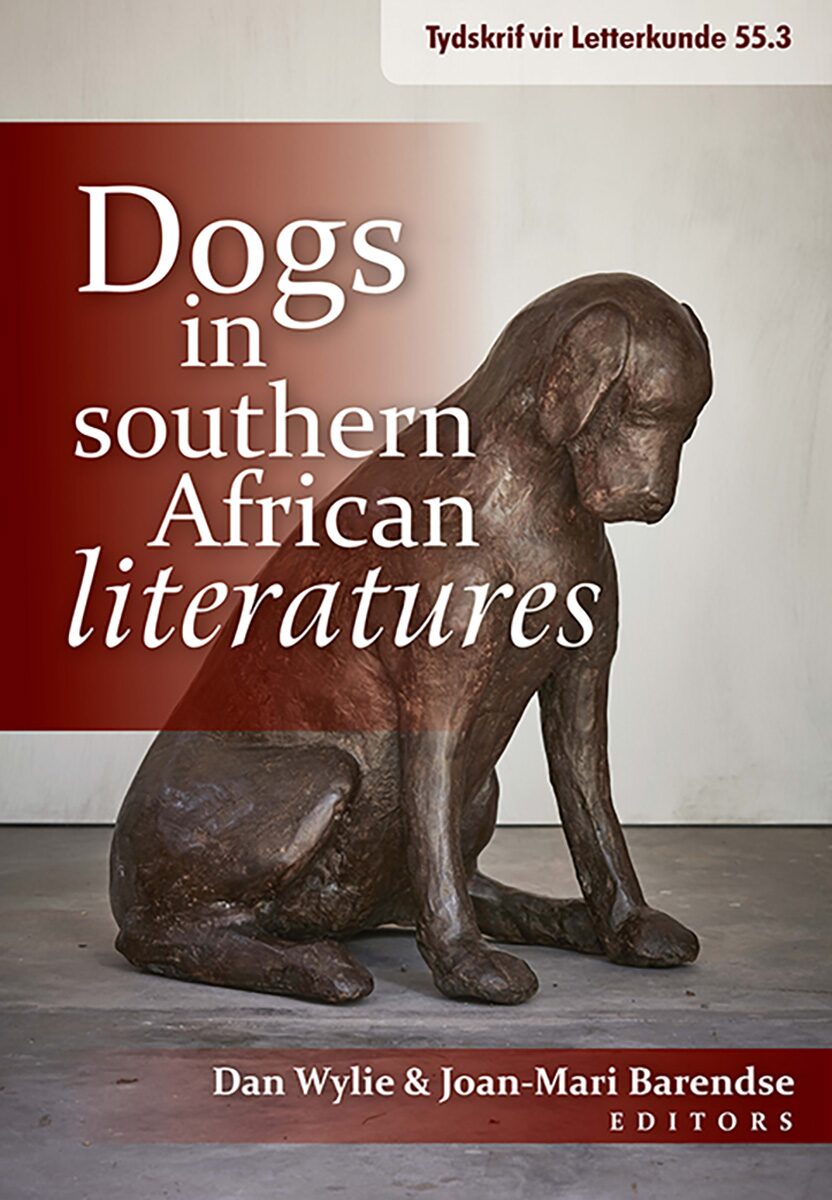
Where are the dogs in southern African literature? The short answer is: everywhere, if you keep looking. Few texts centralise them, but they appear everywhere in the corners of people’s lives: pets walking alongside, strays in the alleys, accompanying policemen, at the dog shows, outhunting, guarding gates. There are also the related canids— jackals, hyenas, wolves—making real and symbolic appearances. Dogs have always been with us, friends and foes in equal measure.
This is the first collection of studies on dogs in southern African literatures. The essays range across many dogs’ roles: as guides and guards, as victims and threats. They appear in thrillers and short stories. Their complex relations with colonialism and indigeneity are explored, in novels and poetry, in English as well as Shona and Afrikaans. Comparative perspectives are opened up in articles treating French and Russian parallels. This volume aims to start a serious conversation about, and acknowledgement of, the important place dogs have in our society.
Dan Wylie teaches English at Rhodes University, Grahamstown, South Africa. He has published three books on the Zulu leader Shaka (Savage Delight: White Myths of Shaka, Myth of Iron: Shaka in History, both UKZN Press, and Shaka (Jacana)); a memoir; Dead Leaves: Two Years in the Rhodesian War (UKZN Press); and several volumes of poetry. The Road Out won the Olive Schreiner and Ingrid Jonker prizes. Most recently, he has concentrated on Zimbabwean literature and on ecological concerns in literature. He founded the annual Literature & Ecology Colloquium in 2004, and edited the collection of essays, Toxic Belonging? Identity and Ecology in Southern Africa (Cambridge Scholars Press). He has edited a volume of essays, No Other World: The Life-work of Don Maclennan (PrintMatters) and Don Maclennan: Collected Poems (Printmatters, 2012). His latest publications are Elephant and Crocodile, both in the Reaktion Books Animals series, and Slow Fires (poems with etchings by Roxandra Britz; Fourthwall Books).
Joan-Mari Barendse received her PhD in Afrikaans literature in 2013 from Stellenbosch University. The topic of her research was Afrikaans dystopian novels published after 1999. From 2013 to 2014 she conducted postdoctoral research on dystopian and apocalyptic/post-apocalyptic South African literature. She lectured at the University of South Africa from 2014 to 2015. In 2016 and 2017 she undertook a postdoctoral research project on the representation of insects and other animals in South African literature within the framework of human-animal studies.
Introduction: Dogs in every corner – Dan Wylie & Joan-Mari Barendse
Dog stories and why they matter – Karla Armbruster
Take a bow: Art and dog communication – Wilma Cruise
“We are all souls”: Dogs, dog-wo/men and borderlands in Coetzee and Tyulkin – Henrietta Mondry
Dog guides as witnesses with specific reference to Miles and Houellebecq – Catherine du Toit
Canine embodiment in South African lyric poetry – Wendy Woodward
Symbolic values of the dog in Afrikaans literature – Gerda Taljaard-Gilson
Afrikaans stories of Jackal and Hyena: Oral and written traditions – Jacomien van Niekerk 80
Oswald Pirow’s Ashambeni (1955): a “history” of dogs, humans, werewolves – Joan-Mari Barendse
On queerly reading canid tropes in Eben Venter’s Wolf, Wolf – Wemar Strydom
Dark ecology and the representation of canids in Deon Meyer’s Fever – Bibi Burger
Canine agents in two South African short stories – Mathilda Slabbert
History, politics and dogs in Zimbabwean literature, c.1975–2015 – Innocent Dande & Sandra Swart
Wildness and colonialism in “The Story of Two Dogs” by Doris Lessing – Pat Louw
“They’ve killed the dogs!”: Land, literature and canines in contemporary Zimbabwe – Dan Wylie
All of our printed books are sold through Takealot, a leading book retailer and distributor in South Africa. By clicking "Continue", you'll be redirected to their website, where you can complete your purchase.
All of our printed books are sold through Snapplify, a leading ebook retailer and distributor in South Africa. By clicking Continue, you'll be redirected to their website, where you can complete your purchase.