
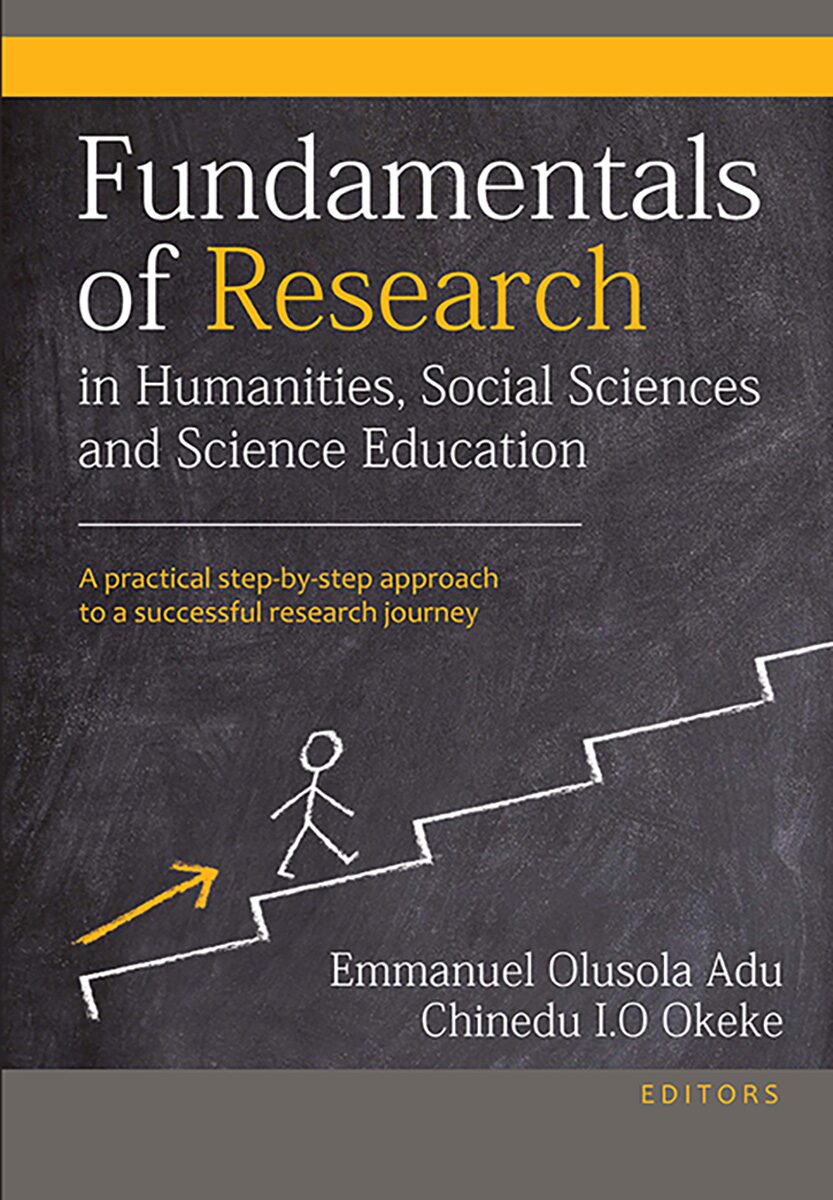
In the global south, and South Africa in particular, the increasing demographic, economic and political weight of this part of the world is calling for the development of research capacity, which has so far been lacking, to guide society in making informed choices that suit and enhance the African culture and context. Fundamentals of research in Humanities, Social Sciences and Science Education follows all the steps of the research endeavour, from the selection and formulation of a research problem, to the writing or reporting, to the publication of research results.
Fundamentals of research in Humanities, Social Sciences and Science Education is informed by practical experience. It is easy to read and understand, is context based and interactive, and can be used for self-study.
Contents include, among others, the following:
Fundamentals of research in Humanities, Social Sciences and Science Education is aimed at students and novice researchers.
Prof. Emmanuel O. Adu is an inaugurated professor in the School of General and Continuing Education and acting deputy dean of research and internationalization of the Faculty of Education at the University of Fort Hare, South Africa. He has taught for over 21 years at universities in Nigeria, Botswana and South Africa, and has over 200 publications to his credit.
Prof. Chinedu I. Okeke is a professional teacher trainer and an academic researcher, and is currently head of the School of Education Studies at the University of the Free State, Bloemfontein, South Africa.
PART 1 THE CONTEXT OF EDUCATIONAL RESEARCH
Chapter 1 Identification and selection of a research topic
Chapter 2 Doing your background to the study
Chapter 3 Dynamics of a good research problem statement
Chapter 4 What makes the significance of the study plausible?
Chapter 5 The general purpose and specific objectives of the research
Chapter 6 Designing the main and the sub-research questions
Chapter 7 Research hypothesis and relationships with statistical tools
Chapter 8 Scope/delimitations of the study and definition of operational terms
PART 2 STRUCTURE OF THE LITERATURE REVIEW AND THEORETICAL FRAMEWORK
Chapter 9 The essence of the literature review
Chapter 10 The link between theory, empirical studies and research
PART 3 METHODOLOGICAL ISSUES
Chapter 11 The synergy between paradigms and research approaches
Chapter 12 Research designs: meaning, rationales and types
Chapter 13 The research study site
Chapter 14 Target population, samples and sample selection
Chapter 15 Selecting your instruments for data collection
Chapter 16 Validity, reliability, piloting and instrument trustworthiness
Chapter 17 Data collection procedures
Chapter 18 Data analysis and interpretation procedures
Chapter 19 Ethical issues in humanities, social sciences and science education
PART 4 REPORTING THE RESEARCH PRODUCT
Chapter 20 Presentation of qualitative research results
Chapter 21 Hypothesis testing and reporting of quantitative research results
Chapter 22 Presentation of the summary of the research findings
Chapter 23 Discussion of the research findings
Chapter 24 Key steps in presenting the summary of a study
Chapter 25 Writing a good conclusion to a study
Chapter 26 Writing limitations, recommendations and suggestions for further studies
Chapter 27 Avoiding plagiarism and writing good references in research
All of our printed books are sold through Takealot, a leading book retailer and distributor in South Africa. By clicking "Continue", you'll be redirected to their website, where you can complete your purchase.
All of our printed books are sold through Snapplify, a leading ebook retailer and distributor in South Africa. By clicking Continue, you'll be redirected to their website, where you can complete your purchase.