COMMENTARY ON EDUCATION LAW AND POLICY
FIRST EDITION 2026
Coming soon
I you are interested in subscribing to this publication, please click the button below and send us your details.
Commentary on education law and policy is a scholarly and practical contribution to the study and development of education law in South Africa. Bringing together leading voices in the field, this publication examines the legal and policy frameworks that shape the right to education, access, governance, funding, administrative justice, discipline, school safety, labour issues, inclusive education, and the rights of vulnerable learners.
The work recognises that education law is not confined to legislation, policy documents, or court judgments; it is applied daily in schools, governing body decisions, departmental administration, disciplinary processes, funding arrangements, and learner-support interventions. It therefore offers critical, authoritative, and contextually grounded commentary on the relationship between constitutional principles, institutional responsibilities, and the practical realities of schooling.
Written for researchers, legal practitioners, academics, policymakers, school governing bodies, education managers, and officials in departments of education, this commentary is a valuable resource for those who study, interpret, apply, or develop education law and policy. It invites rigorous engagement with the rights, duties, and institutional choices that shape meaningful, accessible, fair, and accountable education in South Africa.
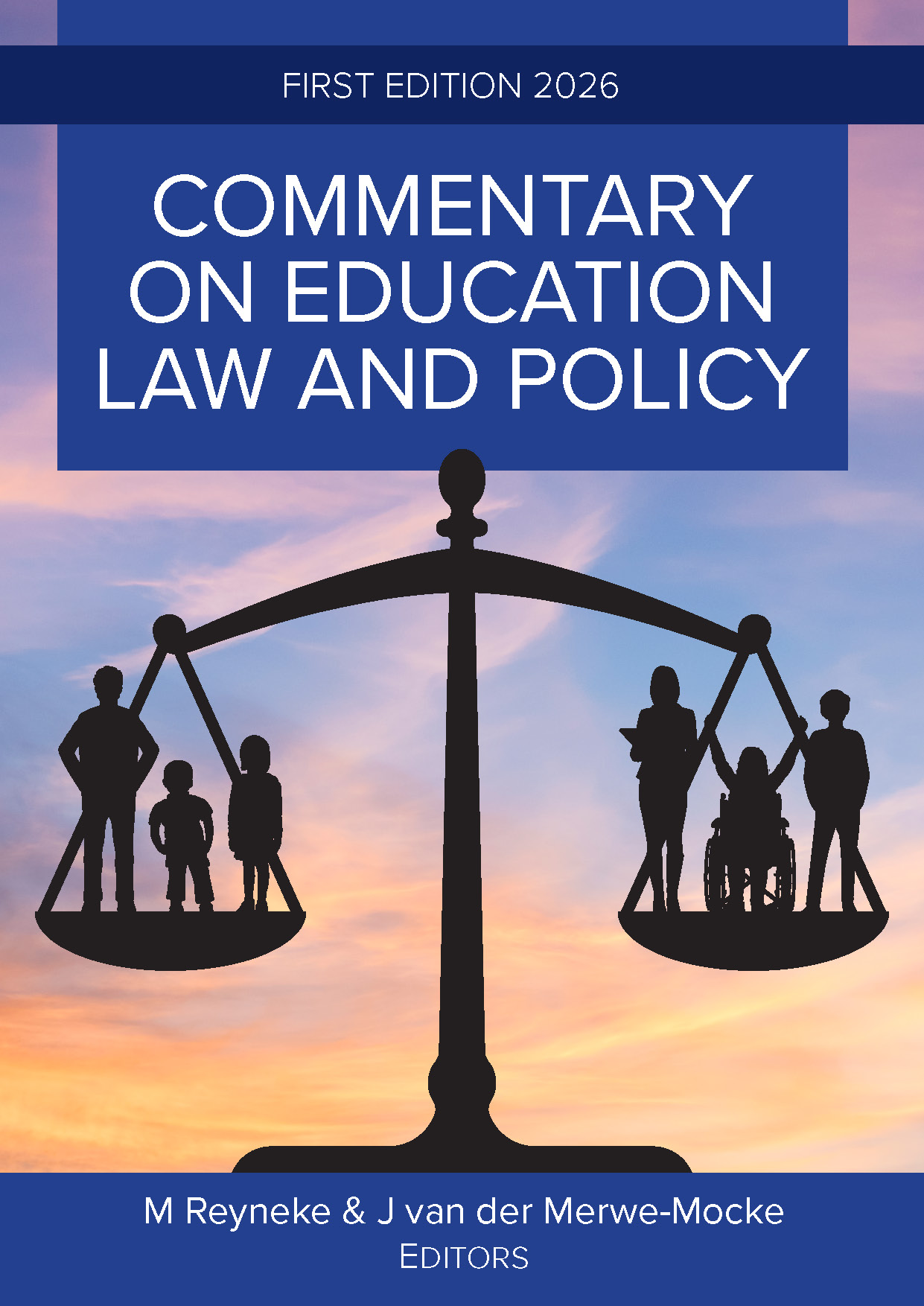
Table of contents
Click on the relevant link to access the required volume.
View the each volumes complete table of contents by collapsing the arrow.
Grey volumes or chapters are planned for future editions.
VOLUME 1:
EDUCATION, HUMAN RIGHTS AND LITIGATION IN EDUCATION
Chapter 1: The right to education in International Law
Details to follow
Chapter 2: The right to education in South Africa
1. Introduction: The Constitution as a transformative project
2. Legal and international framework
3. Development of education law and policy: Historical evolution
4. Judicial interpretation as transformative force
5. Current debates and critical reflections: Ongoing struggle for transformation
6. Conclusion: unfinished transformation project
Chapter 3: Access to Education
1. Introduction
2. Legal and constitutional framework
3. Non-discrimination as a dimension of access
4. Physical accessibility
5. Financial accessibility
6. Admission to public schools: legal principles and practice
7. Language and cultural inclusion within the broader access framework
8. Conclusion
Bibliography
Chapter 4: The right to language and culture
Details to follow
Chapter 5: Alternatives to litigation
Details to follow
VOLUME 2:
SCHOOL GOVERNANCE AND SCHOOL MANAGEMENT
Chapter 1: School governance
Details to follow
Chapter 2: School finance
1. Introduction
2. School governing bodies’ financial management role in public schools
3. Management responsibilities of the principal
4. School funding and state obligations
5. Financial management and oversight
6. School fees and exemptions
7. Corporate governance in accountability and reporting
8. Additional remuneration (Section 38a)
9. Challenges and practical realities in financial governance
10. Recommendations
11. Further comments and recommendations integrating schools into the modern economy
12. Conclusion
Bibliography
Chapter 3: Administrative Law in Education
1. Introduction
2. Constitutional and legislative framework
3. Scope of administrative justice in education
4. Case law on administrative justice in education
5. Case law on key areas that require adherence to administrative law principles
6. Current challenges and debates in implementing administrative justice in education
7. Recommendations for strengthening justice in education
8. Conclusion
Chapter 4: Co-operative governance in Education
Details to follow
VOLUME 3:
SCHOOL DISCIPLINE
Chapter 1: Legal context of school discipline
Details to follow
Chapter 2: Disciplinary hearings
Details to follow
VOLUME 4:
SCHOOL SAFETY
Chapter 1: School safety and the duty of care
Details to follow
Chapter 2: Educator-on-Learner Violence
Details to follow
Chapter 3: Learner-on-Learner Violence
Details to follow
Chapter 4: Learner-on-Educator Violence
Details to follow
Chapter 5: Infrastructure and workshops
Details to follow
Chapter 6: Drugs, dangerous, weapons, and search and seizures
Details to follow
Chapter 7: Sport
Details to follow
Chapter 8: The digital world
Details to follow
VOLUME 5:
LABOUR ISSUES IN EDUCATION
Chapter 1: Labour Law overview
Details to follow
VOLUME 6:
INCLUSIVE EDUCATION AND VULNERABLE CHILDREN
Chapter 1: Inclusive education
Details to follow
Chapter 2: Bridging the gap: Harmonising the right to basic education and social services in South African Schools
1. Introduction
2. Conceptualising social services in the educational context
3. International and regional legal instruments
4. Jurisprudence on schools’ obligation to provide access to social services
5. Adverse childhood experiences (aces) and the right to protection
6. The duty of inter-departmental collaboration
7. Educators and school social workers acting in loco parentis
8. Current debates
9. Conclusion
Bibliography
Chapter 3: Learners with disabilities
Details to follow
Chapter 4: Learners from the LGBTQ community
Details to follow
Chapter 5: Undocumented learners
Details to follow
Chapter 6: Ancestral calling
Details to follow
Preface
Education law is concerned with one of the most important questions in a constitutional democracy: how the right to education is understood, protected, and given practical effect. In South Africa, this question cannot be answered by legislation, policy, or case law alone. It must also be answered in the daily life of schools, in the decisions of governing bodies and education authorities, in the work of educators and support professionals, and in the lived experience of learners, parents, and communities.
Commentary on education law and policy was born from the need for a scholarly, critical, and practically useful work on contemporary education law in South Africa. The field has developed rapidly through constitutional interpretation, legislative reform, policy development, litigation, and the changing realities of schooling. Yet education law remains a field in which principle and practice must constantly speak to one another. Rights must be understood, but they must also be implemented. Powers must be defined, but they must also be exercised lawfully and responsibly. Policies must be drafted, but they must also work in real schools with real constraints.
This publication is intended for researchers, legal practitioners, academics, policymakers, school governing bodies, education managers, officials in departments of education, and all those who work in, study, or engage with education law. It offers more than a description of legal rules: commentary that is analytically sound, practically grounded, and open to critical engagement. It is written for readers who wish to understand not only what the law provides, but why it matters, where its tensions lie, and how it shapes the governance and delivery of education.
The themes addressed in this work reflect the breadth and complexity of education law. The chapters engage with the right to education, access, language and culture, school governance, funding, administrative justice, co-operative governance, discipline, school safety, labour issues, inclusive education, and the position of vulnerable children. These topics are not isolated from one another; they form part of a single constitutional and institutional landscape in which decisions about one issue often affect many others. Access to education is connected to funding and capacity; governance is connected to accountability and administrative justice; discipline is connected to dignity and safety; and inclusion is connected to social support, health care, and the removal of barriers to learning.
The publication is written in the spirit of constructive debate. Education law is a living field, developing through courts, classrooms, policy processes, public institutions, scholarship, and practice. Many of its most important questions require careful balancing: the relationship between school autonomy and State oversight, the role of school governing bodies, the scope of departmental powers, the content of the right to basic education, the obligations created by school safety, and the meaning of inclusion in a deeply unequal society. This commentary does not attempt to provide the final word on these questions; it aims to contribute to informed, principled, and rigorous discussion.
The project is closely connected to the work and spirit of the South African Education Law Association (SAELA). SAELA provides a space for academic debate, professional exchange, and reflection on the legal and policy questions that shape education. This publication forms part of that broader commitment to strengthen education law as a field of scholarship and practice, and to encourage dialogue between academics, practitioners, policymakers, education officials, and those involved in the governance and management of schools.
As editors, we approached this work with a shared commitment to scholarship that is both rigorous and useful. The editorial process was guided by the conviction that education law must be studied critically, but also understood in relation to the institutions, communities, and practical realities it serves. The aim was therefore to bring together contributions that are academically sound, contextually aware, and capable of assisting those who must interpret, apply, and develop education law in South Africa.
We express our sincere appreciation to the contributing authors whose scholarship, insight, time, and commitment made this publication possible. Their thoughtful engagement with complex and contemporary questions in education law and policy gives the publication its depth, breadth, and distinctive value. The richness of this work lies in the range of perspectives brought to the field by authors working across academic, professional, and practical contexts.
We also extend our appreciation to Van Schaik Publishers for their support of this project and for recognising the value of a dedicated scholarly publication offering commentary on South African education law and policy. Their role in bringing this work to publication is gratefully acknowledged.
We further acknowledge the broader community of educators, school governors, officials, practitioners, researchers, and learners whose experiences continue to raise the questions that education law must answer.
We hope that this publication will serve as a valuable resource for study, legal practice, governance, administration, policymaking, and further research. More importantly, we hope that it will encourage careful, responsible, and courageous engagement with law as one of the instruments through which meaningful, accessible, fair, and accountable education may be advanced in South Africa.
Prof Mariëtte Reyneke
Dr Juané van der Merwe-Mocke
Introduction
Education law in South Africa operates at the intersection of constitutional principle, public administration, institutional governance, and the daily realities of schooling. It is a field concerned not only with the recognition of rights, but with the structures, decisions, and duties through which those rights are protected and given practical effect. The right to a basic education, the best interests of the child, equality, dignity, language and cultural rights, administrative justice, school governance, and accountability all form part of this legal landscape.
This publication approaches education law and policy as an integrated field of study and practice. Education law cannot be understood by reading legislation and case law in isolation; it must also be understood in relation to policy instruments, departmental administration, school governance, institutional capacity, professional responsibilities, and the lived experience of learners, parents, educators, and communities. A legal rule may appear clear in principle, but its application often requires careful judgment about resources, competing rights, public power, institutional roles, and the practical realities of schools.
South Africa’s education system remains shaped by a complex constitutional and institutional history. The democratic legal framework created after 1994 placed education at the centre of the constitutional project by recognising basic education as a fundamental right and by requiring the State to respect, protect, promote, and fulfil the rights in the Bill of Rights. However, more than three decades into democracy, many of the most difficult questions in education law no longer concern only the legacy of the past; they also concern the effectiveness of present governance, the quality of administration, the rationality of policy choices, the allocation and use of resources, the accountability of public institutions, and the ability of schools and departments to give practical effect to constitutional commitments.
The right to a basic education is therefore a central organising theme of this work. It is not merely a symbolic statement of constitutional aspiration; it imposes direct obligations and requires a functioning system capable of providing access to meaningful education. This includes schools, infrastructure, educators, learning materials, safety, governance, funding, fair procedures, and appropriate support for learners. The chapters dealing with the right to education and access to education emphasise that the recognition of a right is only the beginning of the inquiry; the more difficult question is whether the legal and institutional framework enables that right to be realised in practice.
A recurring theme throughout this publication is that education law must be understood as both rights-based and institutionally grounded. Rights are asserted and protected within real institutions: schools, school governing bodies, provincial education departments, the national Department of Basic Education, courts, professional bodies, and support services. The functioning of these institutions determines whether education law remains an abstract statement of principle or becomes a practical instrument of fairness, accountability, and access.
This institutional dimension is particularly visible in the relationship between school governance and State oversight. The South African Schools Act created a model of democratic school governance in which school governing bodies play a central role, while the State retains the ultimate responsibility to ensure that the right to education is realised. This relationship is necessary, but often contested. Questions about admission, language, school capacity, finance, discipline, policy-making, and accountability frequently require a careful balance between the lawful powers of schools and the oversight responsibilities of education authorities.
The chapters on school governance, school management, school funding, administrative justice, and co-operative governance are situated within this broader framework. They examine how authority is allocated, how public power must be exercised, and how legal duties should be understood by those responsible for governing, managing, and administering schools. School funding, in particular, demonstrates that legal compliance and practical stewardship cannot be separated. Financial governance is not merely an internal administrative function; it is directly connected to the ability of schools to provide quality education, maintain accountability, and serve the best interests of learners.
Administrative justice is equally central to education law. Decisions made by education officials, school governing bodies, principals, and other decision-makers may have significant consequences for learners, parents, educators, and school communities. Decisions about admission, placement, language, discipline, appointments, resource allocation, and school policy must be lawful, reasonable, and procedurally fair. The chapter on administrative justice explains how the constitutional right to just administrative action and the Promotion of Administrative Justice Act 3 of 2000 operate in the education context, and why fairness and legality are essential to accountable education governance.
This publication also recognises that education cannot be meaningful where learners and educators are unsafe. School safety is not a separate concern standing outside education law; it is a condition for teaching and learning and a legal duty connected to care, supervision, accountability, and the best interests of the child. The chapters on school safety consider the duty of care, the principle of in loco parentis, violence in schools, infrastructure risks, drugs and dangerous weapons, search and seizure, sport, and the digital environment. These issues demonstrate that safety requires more than rules and disciplinary measures; it requires prevention, policy development, responsible supervision, institutional capacity, and co-operation between schools, departments, families, and other role-players.
Discipline is addressed within the same constitutional and educational framework. School discipline is necessary for an environment conducive to teaching and learning, but it must be exercised consistently with dignity, fairness, legality, and the best interests of the child. Disciplinary processes therefore require more than a response to misconduct; they require a proper understanding of authority, procedure, evidence, proportionality, educational purpose, and the rights of affected learners.
Labour issues in education are also part of the broader legal framework within which schools operate. The employment relationship in schools is shaped by labour law, education legislation, professional standards, collective agreements, and the operational needs of the education system. Labour disputes, appointments, performance, misconduct, and institutional relationships affect not only employees and employers, but also the stability and effectiveness of the learning environment.
Inclusive education and vulnerable learners form an important part of this publication’s treatment of education law and policy. The right to basic education belongs to every learner, but its realisation often requires more than formal admission to a school. Learners may experience barriers related to disability, poverty, documentation, trauma, social vulnerability, language, identity, health, or family circumstances. The chapter on social services in schools illustrates that the right to education may be closely connected to the rights to social services, basic health care, care, and protection. Where learners face trauma, neglect, disability, or other barriers to learning, education law must be understood together with the systems of support required to make meaningful participation possible.
The structure of this publication reflects this broad and connected approach. The first volume situates education within the human rights and litigation framework, dealing with the right to education in international and South African law, access to education, language and culture, and alternatives to litigation. The second volume turns to school governance and school management, including governance structures, school finance, administrative justice, and co-operative governance. The third volume addresses school discipline. The fourth volume focuses on school safety. The fifth volume deals with labour issues in education. The sixth volume considers inclusive education and vulnerable children. Together, these volumes provide a comprehensive commentary on the legal and policy issues that shape education in South Africa.
This publication adopts a commentary-based approach, seeking not merely to restate legislation, policy, or case law, but to analyse, question, and explain. It invites readers to consider not only what the law provides, but how it should be interpreted, applied, and developed in light of constitutional values and practical realities. This is particularly important in education law, where legal questions often require careful balancing and where the consequences of legal decisions are felt directly by learners, schools, and communities.
The intended audience is deliberately broad. Researchers may use this publication as a foundation for research and critical engagement. Legal practitioners may use it to understand the statutory, constitutional, and policy context within which education disputes arise. Academics may find in it a basis for further scholarship and debate. School governing bodies, principals, and education managers may use it to inform governance and decision-making. Officials in departments of education may use it to support lawful, fair, and rational administration. Policymakers may use it to consider how law, policy, and implementation interact in practice.
Education law in South Africa continues to evolve. Legislative amendments, policy reform, litigation, administrative practice, and social change regularly reshape the field. This development creates opportunities for improvement, but also uncertainty, contestation, and the need for careful legal analysis. The purpose of this commentary is not to remove all uncertainty or to provide final answers to every question; rather, it offers a principled framework within which difficult questions may be considered with rigour, context, and responsibility.
Ultimately, education law is about the conditions under which teaching and learning take place. It concerns rights, but also duties; autonomy, but also accountability; policy, but also implementation; institutions, but also people. It requires attention to constitutional principle and to the practical realities of schools. This publication is offered as a contribution to the continuing task of understanding, applying, and developing education law in a manner that advances meaningful, accessible, fair, and accountable education in South Africa.
About the authors
Prof Mariëtte Reyneke
Mariëtte Reyneke teaches and supervises post graduate students in Education law in the Faculties of Law and Education as well as the Centre for Human Rights at the University of the Free State. Her research focuses on school discipline, children’s rights, and restorative justice in education. She is a trained lawyer, mediator and is passionate about building and restoring relationships through the application of restorative practices. She often presents courses on restorative practices in school discipline to teachers. She is currently the President of the South African Education Law Association and editor of the book Restorative Discipline. The Law and Practice and is the editor of the Journal for Juridical Science. She is an NRF rated researcher and serves on the board of SACE.

Dr Juané van der Merwe-Mocke
Juané van der Merwe – Mocke is the Deputy CEO of the Federation of Governing Bodies of South African Schools (FEDSAS) and also heads the organization’s legal department. In this role, she is actively involved in developing school policies, providing legal opinions, and advising schools on matters related to education law. She also serves on several task teams of the Department of Education that are involved in drafting legislation to be promulgated under the Schools Act. Juané is a member of the executive committee of the South African Education Law Association and holds both LLB and LLM degrees, along with a doctorate (LLD) in Education Law. She is an admitted attorney, conveyancer, and notary. Additionally, Juané has co-authored several textbooks, including Diversity and Difference in South African Schools, Financial Management in Public Schools, and the Case Law Handbook on Education. She is a frequent speaker at national education events and has extensive experience consulting with schools on practical legal issues in the educational environment.

Maitumeleng Nthontho
Prof. Maitumeleng Albertina Nthontho is a Research Professor and a C2 NRF-rated researcher in the Education and Human Rights in Diversity Research Unit, Faculty of Education, North-West University, Potchefstroom, South Africa. She holds both Master’s and Doctoral degrees in Education Management, Law and Policy. Her scholarly work is located at the intersection of education leadership, law, and human rights, with a particular focus on issues of diversity, governance, and accountability in schooling. Her research interests include human rights in education, school leadership, education law and policy, and religious diversity in schools. Prof. Nthontho’s expertise spans education management and leadership, education law and policy, and school governance, with her work contributing to policy-informed leadership practices and sustainable social change in South African education.

Carita Visser
Carita Visser is a Legal Officer at FEDSAS (Federation of Governing Bodies of South African Schools), where she provides legal advice and governance support to public school governing bodies across South Africa. She holds an LLB and LLM from the University of the Free State and completed her articles of clerkship at Horn & Van Rensburg Attorneys. With over three years’ post-admission experience in education law, her work focuses on statutory interpretation, education and administrative law, and school governance compliance. She is also a PhD candidate at the University of the Western Cape, where her research engages broader questions of reconciliation.

Dr Jaco Deacon
Dr Jaco Deacon has served as the Chief Executive Officer of the Federation of Governing Bodies of South African Schools (FEDSAS) since 2021. He also serves as a trustee of the South African Education Development Trust and is involved with various organisations and institutions. He is a legal scholar with a Doctor of Law (LLD) degree specialising in labour law and is a former lecturer at the University of the Free State.
Jaco is the editor of the Juta Education Law and Policy Handbook and the Case Law Handbook. He is the author of several publications, including School Governance: Answers to Everyday Challenges, Human Resource Management in Public Schools, and Financial Management in Public Schools, and is also the compiler of Pocket Laws: School Governance and the Law.
Jaco began his career as an attorney and has been involved with FEDSAS since 2008. Education law attracted his interest early in his career, and FEDSAS was one of his first clients. He has been appointed by both the Minister of Labour and the Minister of Basic Education to serve on various national task teams.
He is also a regular speaker at national and international events and has published numerous research papers in accredited academic journals. Jaco’s views are frequently sought by the media, and he is regularly approached to comment on education-related matters.
Jaco is married to Tamari, a teacher, and they have three children. The family enjoys camping and farm life, and Jaco is also an enthusiastic road runner who has completed the Comrades Marathon on several occasions.

Ebrahiem Daniels
Ebrahiem is a legal advisor in local government at the City of Cape Town Municipality, Office of the City Manager. He provides legal services to the City Manager in respect of all appeals lodged in terms of the Municipal Systems Act, assists in the resolution of supply chain management disputes and assists in combating abuse of the supply chain management policy by conducting investigations, drafting notices, rulings and sanctions.
Prior to joining local government, Ebrahiem was a public interest attorney specializing in education law and policy at the Equal Education Law Centre. His work at the law Centre focused on the protection of children’s right to basic education. Ebrahiem’s passion for education now finds expression through the South African Education Law Association.

George Moroasui
George Oupa Moroasui is the National Development Officer at the Federation of Governing Bodies of South African Schools (FEDSAS), a position he now holds for three years. He previously served for 16 years as Manager: Legal Affairs and Ethics (Discipline) at the South African Council for Educators (SACE). He also served as a Legal Officer at the Engineering Council of South Africa (ECSA) for two years and at the Department of Labour for one year. Before joining the public and regulatory sector, he spent 10 years in active private legal practice. George has extensive experience in education law, school governance, labour relations, educator discipline, investigations, professional ethics, and legal compliance. He advises School Governing Bodies, principals, and education stakeholders nationally, bringing a practical and deeply informed legal perspective to accountability, leadership, educator conduct, and learner protection.

Daniel Peter
Daniel Peter is a legal researcher and admitted attorney at the Equal Education Law Centre, specialising in child safeguarding, early childhood development, and education budgeting. He co-represents the EELC on the Budget Justice Coalition and on the Real Reform for ECD (RR4ECD) Steering Committee, and he previously led safeguarding programming in ten Southern African countries at the International Federation of Red Cross and Red Crescent Societies (IFRC).

Me Anjuli Maistry
Anjuli Maistry is a senior attorney at the Equal Education Law Centre. Her interests include children’s rights, migration, climate justice and access to education. She is a co-representative of the EELC on the Real Reform for ECD (RR4ECD) Steering Committee. She has previously worked at Lawyers for Human Rights, the South African Human Rights Commission, the Legal Resources Centre and the Centre for Child Law.

Coenraad Jurgens
Coenraad Jurgens is a senior lecturer at North-West University (NWU) at the Potchefstroom campus. He holds a PhD from NWU (2019), an MEd from NWU (2012), a B.Ed (Hons) from NWU, and an HOD Technical certificate from Potchefstroom Teachers College (1992).
He was a teacher for 22 years, specialising in technical subjects, and served as both an examiner and chief examiner for the North-West Province in the subject of Engineering Graphics and Design.
Coenraad joined NWU in 2013, as a lecturer in the School of Mathematics, Sciences, and Technology, where he taught various modules, including Engineering Graphics and Design, Mechanical Technology (Welding and Metalworking), Civil Technology, Subject Methodology, B.Ed. (Hons), and distance modules.
Coenraad represents NWU in the National Association for Schools of Technology (NAST) and is part of the NWU research unit Edu-HRight. His primary research focus is on Education Law, with specialisations in Risk Management in Technology School Workshops and an interest in Sports Law.

Prof Nicholus Mollo
Nicholus Tumelo Mollo is an Associate Professor of Education Law in the Faculty of Education at North-West University. He holds a PhD in Education Law. His research interest includes discipline in schools, safety in schools, labour law in education, the legal and policy framework that regulate and guide 4IR in education, teacher development, teachers rights and responsibilities, and best practices of South African education leaders. He is one of the founders of Besilindile Primary School and Sinqobile Abet Centre in Emalahleni (Mpumalanga Province). He was a centre manager of Sinqobile Abet Centre, a principal of Ukhwezi Primary School in Belfast and a principal of Emakhazeni Boarding School in Machadodorp (Mpumalanga Province). He is a 2014 National Teacher Award winner (3rd position) at the District level (Nkangala) for Excellence in Primary School Leadership. He is also the NWU Faculty of Education Teaching Award winner for 2024. He has been teaching education law in the distance programme (part-time) of the University of Pretoria for seven years. He also lectured and moderated on a part-time basis at Tshwane University of Technology, University of Fort Hare, University of South Africa and Edutel. He published articles and book chapter with accredited journals and publishers. He is an editor of a professional book called Best Practices of South Africa Public Schools Leaders: A holistic legal-based practice of excellence and a guest editor of the Journal for Juridical Science special edition. He has authored book chapters and articles. He has presented papers in local and international conferences. He is a Deputy President of the South Africa Education Law Association and a member of the International Journal for Education Law and Policy Editorial Board.

Prof Roelf Reyneke
Prof. Roelf Reyneke is an Associate Professor in the Department of Social Work at the University of the Free State. His research focuses extensively on child protection and social services within the education sector. With a specialised interest in neuro-pedagogy, he investigates how Adverse Childhood Experiences (ACEs) affect learning and advocates for trauma-informed approaches to safeguard learners’ neurological integrity. He has published on the legal and ethical obligations of school social workers and the role of restorative practices in addressing bullying and school safety.
As a leader in the training of social service professionals, Prof. Reyneke developed and currently coordinates the Master’s in School Social Work programme at the University of the Free State. He serves as a field instruction coordinator and is an external examiner for postgraduate school social work programs nationally. His expertise is further recognised through his role as a member of the advisory panel on psychosocial services for the Department of Basic Education within the Directorate of Inclusive Education. Prof. Reyneke is dedicated to equipping practitioners with the legal and therapeutic tools necessary to protect children and fulfill their right to education.

Riaan van der Bergh
Riaan serves as Deputy CEO of FEDSAS and also heads up the FEDSAS Centre for Technology and Centre for Finance and Risk Management.
He has been with FEDSAS for 10 years and has contributed to publications on School Governance and Teacher training. He is a regular speaker on Education technology as well as general education matters at conferences and in the media. He has served as the SAELA (South African Education Law Association) Treasurer for the past five years. Riaan has contributed to various publications for like Financial Management in Public Schools, Help, I’m a student teacher and “Uitnemende Onderwys”. He holds an honours degree in accounting and completed accounting articles with KPMG.
Riaan is passionate about education and has devoted the past 14 years to research and consultation and advice on the sensible use of the tools of our time to better learning outcomes. He is married and has two children aged 16 and 15 and also serves on the SGB of his kids’ school.

Gerhard van Niekerk
Gerhard was born in Toronto, Canada, and his family returned to South Africa when he was quite young. He grew up in the beautiful town of Stellenbosch, and matriculated at Paul Roos Gymnasium.
Gerhard did a BA LLB degree at Stellenbosch University, and then joined the Department of Justice, first as a prosecutor and later as a Magistrate in the Magistrates’ Court. Gerhard joined DKVG in 1994 as a Candidate Attorney. On his admission as an Attorney in 1996, he became a Professional Assistant. He was appointed a Director of the firm in 1999.
Gerhard is based at the Tyger Valley branch and specialises in all aspects of commercial law, matrimonial law, banking law, law of contracts, and other commercial litigation in the High Court. He acts on behalf of major banking groups, private school entities, insurance companies, IT companies, and small and medium businesses, and has been involved in various BEE companies since their inception.
Gerhard has been a member of the South African Education Law Association for many years, and sits on its exco committee. Over the years, Gerhard has given his time to several charitable causes including children’s homes in Merweville and Durbanville, and the Thando Trust.
Gerhard’s interests include running, cycling (at last count he’d done 22 Cape Town Cycle Tours!), and the great outdoors. His favourite places in South Africa are the Cederberg and the Tsitsikamma National Park.

Anri van Niekerk
Anri van Niekerk was born and raised in Cape Town and matriculated from Durbanville High School. She obtained her Bachelor of Education (Foundation Phase) and Postgraduate LLB degrees from Stellenbosch University.
Anri completed her articles of clerkship at De Klerk & Van Gend Inc in 2024, where she continues to practice as an Associate. She is an admitted Attorney, Conveyancer and Notary Public.
Anri has developed experience across a broad range of legal disciplines, with particular interests in education law, property law, and family law.