
Managing time

Managing time
The majority of students complain about time and we are the ones who always misuse “this little time” we have by sitting around complaining about the accent of that lecturer and that the lecturing pace is really fast, but I’ve learnt that complaining about it makes it even faster because I’ve lost time while I was complaining. (First-year student, Wits University)
Time is like money – you only have a limited amount of it and you have to decide carefully how you are
going to spend it. You have to budget your time, just like you budget your money.
SCHEDULES AND TO-DO LISTS
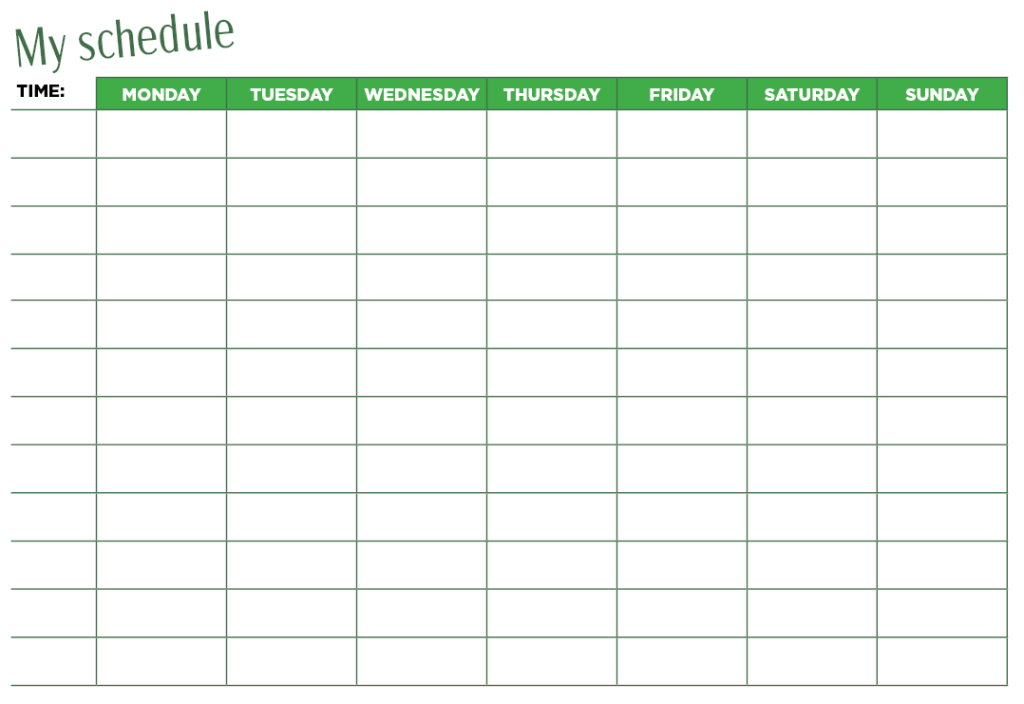
Copy the schedule below to plan your week so that you can get everything done that you have to, and find space for friends and play.
- First fill in your classes and tutorials.
- Next comes study time. Being a full-time student is exactly like having a full-time job: you have to spend about 40 hours a week on your studies. If you spend 15 hours a week in class, you have to schedule another 25 hours of study time. That means about four hours every day, six days of the week. A full-time course is structured to fill that amount of time. If you don’t put in the time, you are not going to get the results.
Only 50% to 60% of people who enrol at university in South Africa ever graduate. Less than 40% get a degree within four years. If you want to be part of that 40%, you have to put in the hours.
Evenings are great for studying: 19:00–20:30, half an hour for coffee, and another session 21:00–22:30 gives you a solid three hours. You will probably take Friday night off, so remember to find those three hours somewhere else in the week.
- Often you have an hour or so between classes. Block out some of these pockets for “free time” when you can just hang with friends or potter about on social media – you need that as well – but don’t let all your days vanish in this way. You can “find” solid hours in those in-between times. Find a quiet place and get some of the less-demanding work out of the way.
- Add scheduled times for sport, clubs, or student affairs.
- Last, but not least, find time for friends and family and for yourself, to read a novel or to listen to music or to do whatever feeds your soul.
Whatever your religious convictions, it may be a good idea to work a bit more on six days every week so that you can give yourself one day off. You will find that it becomes an oasis you look forward to and a motivation to keep going on the other days. We all need a rest day, a day off every week!
Even with a clear schedule, we are often overwhelmed by everything that has to be done in a certain block of time. Where should I start with my studies? What should I do first in my “free” time?
The handy tool below, a time management matrix, has been adapted from Stephen R. Covey’s book The seven habits of highly effective people, first published in 1989 by Free Press.
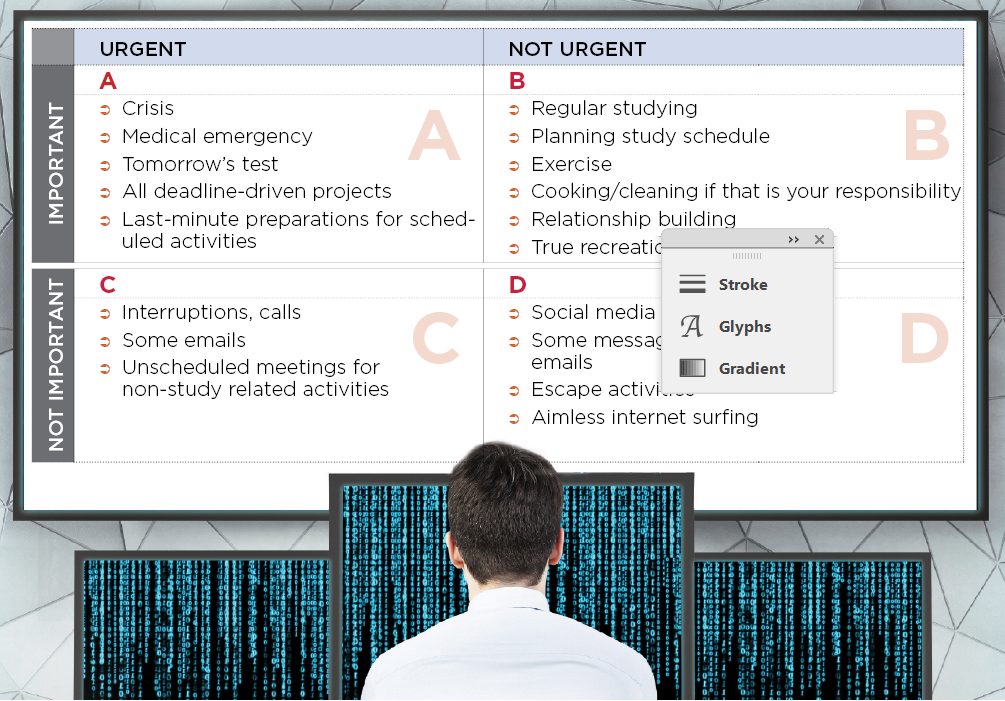
The top two quadrants of the time management matrix are where you have to focus.
- Quadrant A is the urgent and important stuff, which needs to be done NOW. You don’t really have a choice. If you spend all your time in A, however, you function in crisis mode. It could be that you are not planning your time well, or perhaps you are procrastinating.
- Quadrant B is what we often overlook or postpone, because it is not urgent – but it is important. This is what Covey calls the “Quadrant of Quality and Personal Leadership”. These activities require planning and initiative. They also require time to reflect. If you find time for Quadrant B, you are a time manager, not a crisis manager.
- Quadrant C is filled with things we get into because we can’t say no. Learn to do so (i.e. say no).
- Quadrant D contains the things we do because they are easy, mindless, and help us avoid the hard stuff. Social media, binge-watching series … These are the REAL time wasters!
So, when you feel overwhelmed by everything you have to do:
- Make a list of all of those things.
- Consider them according to Covey’s matrix.
- Put the important, urgent ones at the top, followed by the important, not so urgent ones.
- Try to delete the ones that fall into the bottom quadrants.
- Now make a to-do list for today.
- Make another one for this week.
- Start at the top, and do the first one.
 EXERCISE
 EXERCISE
If you never use a car, the battery will go flat and the tyres will perish. Just like a car, our bodies are made to move. Your muscles need to be used. Find a kind of exercise that you enjoy, like walking, running, dancing or playing sport, and do it at least three times a week for at least half an hour at a time. Get into a habit and keep it up throughout your life.
Exercise is also necessary for your brain to work well. The neurons, the little nerve cells which make up the brain and do our thinking, are stimulated by exercise so they work better; and you grow more of them by using them, making learning and life easier.
 SLEEP
SLEEP
 SLEEP
SLEEPYour brain needs sleep to get rid of toxins, to “clean” itself after the day. Sleep also helps you remember what you have learnt, even if that sounds strange. You need between seven and nine hours of sleep a night. Get into a routine. Go to bed at the same time every night and do the same things before going to bed. Don’t read on a screen – the blue light wakes up your brain.
WE NEED SLEEP TIME AND PLAY TIME.
