
Effective study

Effective study
By now you know that every day you allow to slip by makes the next one more difficult. Self-discipline is so boring, but so effective. Once steady, regular studying according to your schedule (p. 11) becomes a habit, you don’t have to make a decision to study every time you do so. That will help, because otherwise it is so easy to say, “I’ll do it later” or “I can miss this class, I’ll catch up tomorrow.” That’s called procrastination: putting stuff off and telling yourself you’ll do it later. We may not know the word, but we all know the feeling!
Studying comes in different shapes and sizes. Use all your available hours wisely.
CLASS TIME
- Stay up to date with the work and prepare for the next class. Proper preparation, also called “priming your mind”, is one of the most under-utilised time-saving techniques. Your brain will automatically make connections if it has been introduced to the main concepts before class.
- Make sure you’re on time so that you hear the lecturer’s introduction, which often frames the day’s work.
- Concentrate and take notes. Try to follow the flow of the lecture while jotting down main points. Review it the same day and fill in all the gaps.
Tutorials
- Tests and exams are based on problems that are similar to those addressed in tutorials. Make sure you attend every tutorial.
- Tutorial groups are smaller and less intimidating than classes at lectures. Speak up. Ask all your questions. That’s what these sessions are for.
STUDY TIME
Like all jobs, studying is not always going to be easy or fun. Some things you will find boring. Other things you may find impossible to understand. Hold on to a few thoughts:
- You are here for a reason. Remember your goal. Remember how this course you have to work at now fits into that bigger picture.
- Henry Ford, who built the world’s first car factory, said: “Whether you say you can or you say you can’t, you’re right.” Believe that you can, and that’s half the battle won. Thousands of others have done it. You can too.
- The more attention you give to a piece of work, the better you will understand it and the more interesting it will become. That obscure poem that was just a jumble of words the first time you read it may be the one you take into life with you.
- Stanford psychologist Carol Dweck distinguishes between people who believe that intelligence is fixed, and people who believe it can grow. If you believe it is fixed, learning feels like a never-ending struggle against your own shortcomings. If you believe it can grow, learning feels like exercise to become fit, and failures (e.g. a failed test, something you initially cannot understand) are stepping stones to greater ability. Change your mindset from “fixed” to “growth”.
BLOOM’S TAXONOMY
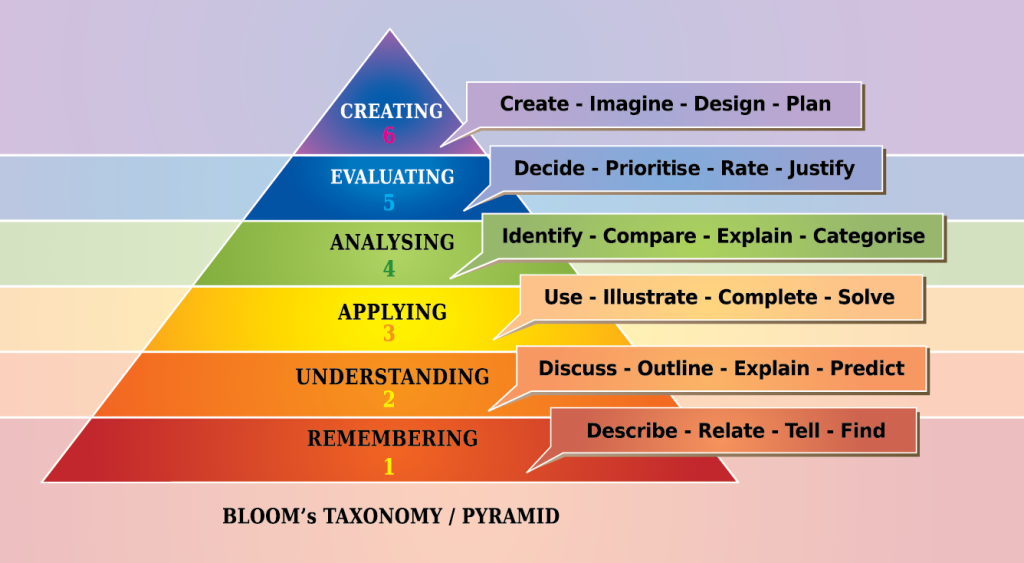
Google Dr Benjamin Bloom’s “Taxonomy of Learning”. It will help you understand the different levels of learning, so that you can consciously progress from one to the other.
- Learning starts with remembering. This occurs when you memorise a poem, recall the nine provinces of South Africa, or remember mathematical formulas.
- The second level is understanding. For example, understanding takes place when you organise the animal kingdom based on a given framework, illustrate the difference between a rectangle and a square, or summarise the plot of a story.
- The third level is applying your knowledge. Application takes place when you use a formula to solve a problem, select a design to meet a purpose, or work out how a new law would progress through a government system.
- On the fourth level you will be analysing information and knowledge. You may identify different elements of democracy, explain how the steps of a scientific process work together, or identify why a machine isn’t working.
- The fifth level is evaluation. Now you may have to make a judgement regarding an ethical dilemma, interpret the significance of a law of physics, or illustrate the relative value of a certain kind of technology in farming.
- The sixth and final level is creation. This is when you design a new solution to an “old” problem, write a persuasive essay that draws on different sources, or write a poem on a given theme.
Keep this framework in mind when you are studying and be aware that your teachers will assess your skill and ability on the different levels. In high school the emphasis was on remembering and understanding. First-year students still have to memorise lots of material, and make sure they understand what they learn, but are also required to apply newly gained knowledge.
These skills must grow further in second year, and as you move towards third year you will increasingly be required to analyse the learning material. Fourth year and Honours students will find it difficult to maintain their good grades if they don’t also learn to evaluate, and at Master’s level you will be required to create new knowledge.
A note on AI (see Digital Literacy section): At the time of writing, Artificial Intelligence is fast becoming part of a new reality. If you are not using it yet, you soon will be doing so. You can find any fact, like the classification of animals and the plots of stories, online in seconds. Even so, you still need to know enough to ask the right question and to evaluate the answer. You need to know that the animal kingdom is organised in a certain way, or that there are geometric figures which play different roles in calculations. You may no longer need to learn the details, but you need to have an overview in your head.
In all your studies, always look for the big picture or the underlying structure of the subject in front of you. Imagine zooming out and getting a bird’s eye view. Use mind maps. Discuss the material with your study group. Understanding and insight will become far more important than knowledge.
FOCUSED AND DIFFUSE THINKING
Learning anything new has an effect on your brain, creating new pathways and new connections. It is one of the most important things you can do as a human being.
Barbara Oakley, an engineering professor who failed maths at school, and who has made it her life’s focus to understand how we learn, explains that your brain is complex*. It has two fundamental modes of functioning: focused and diffuse.
Focused brain function is what we usually define as studying. You really concentrate on the matter at hand, giving your full attention to understand and solve the problem. You zoom in and do not allow distractions.
Diffuse thinking embraces distractions. You let your mind wander freely and allow all kinds of crazy connections. Diffuse thinking usually happens when you are away from your desk – when you go for a walk, or take a shower, talk to friends, or just daydream. It’s a very good idea to go into diffuse thinking mode when you cannot crack a problem. You might see the solution while you are not really looking!
Spending all your time in diffuse mode won’t do. It is the interaction between the two modes that is required to master the art of effective study. Think of a flashlight: you can concentrate the beam to have a bright light illuminating a small area, or have a more diffuse beam casting a dimmer light on a wider area. The brain can concentrate on the details better if it has also seen the bigger picture.
POMODORO TECHNIQUE
Structure your study time by using the “pomodoro technique”. (Francesco Cirillo, the Italian who came up with it, had a tomato-shaped kitchen timer – the word “tomato” is “pomodoro” in Italian.)
- Set your phone or a stopwatch for 25 minutes. Work with focused attention for those 25 minutes. Everything else is turned off.
- When the timer goes off, relax for five minutes. Do something fun, take a power nap, dance to your favourite song.
- Repeat the process three more times, for a total of two hours.
- Then take at least 30 minutes off. This time off allows your brain to go into “diffuse mode”, like a flashlight set to throw a wide, soft beam rather than a sharp, focused one. This helps to lay down new pathways for new learning and may even help you see a solution to something you had been struggling with in the focused time.
- Sets of four “pomodoros” – 25 minutes focused mode and five minutes of relaxation – will give you a great framework to get all your work done.

CHUNKING
Our minds can only hold a few thoughts or ideas at the same time. On the other hand, our minds are always looking for patterns. Put information together to make a pattern, then you can remember much more.
- Use analogies and metaphors, for example: the body is like a city. The arteries and veins are roads carrying trucks with fuel (oxygen and nutrients). The roads are strictly divided:
- only full trucks on arteries, only empty trucks on veins. Draw a rough picture.
- Draw a mind map or some stick figures.
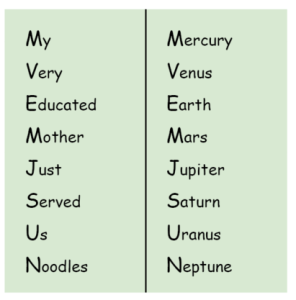
- Make up a mnemonic, a nonsense sentence using the first letters of a list you have to remember, like the order of operations in maths or the names of the planets.
- Build an imaginary “memory palace”, a building in your mind, and “put” every one of the things you need to remember in a specific
- place. Then imagine walking through your building and finding them one by one.
SPACED REPETITION
How do you transfer knowledge or understanding from your working memory into your long-term memory? The same way you would learn a song: practice. Practice makes permanent. The more you practise, the wider and the more embedded the neural pathways become. If you don’t practise, the patterns vanish before they are made permanent.
The best way to practise your new knowledge is by spaced repetition. You may want to Google this term. There are many articles and videos that will help you understand how best to employ the technique. Most of the following ideas come from a video on www.collegeinfogeek.com, but there are many others.
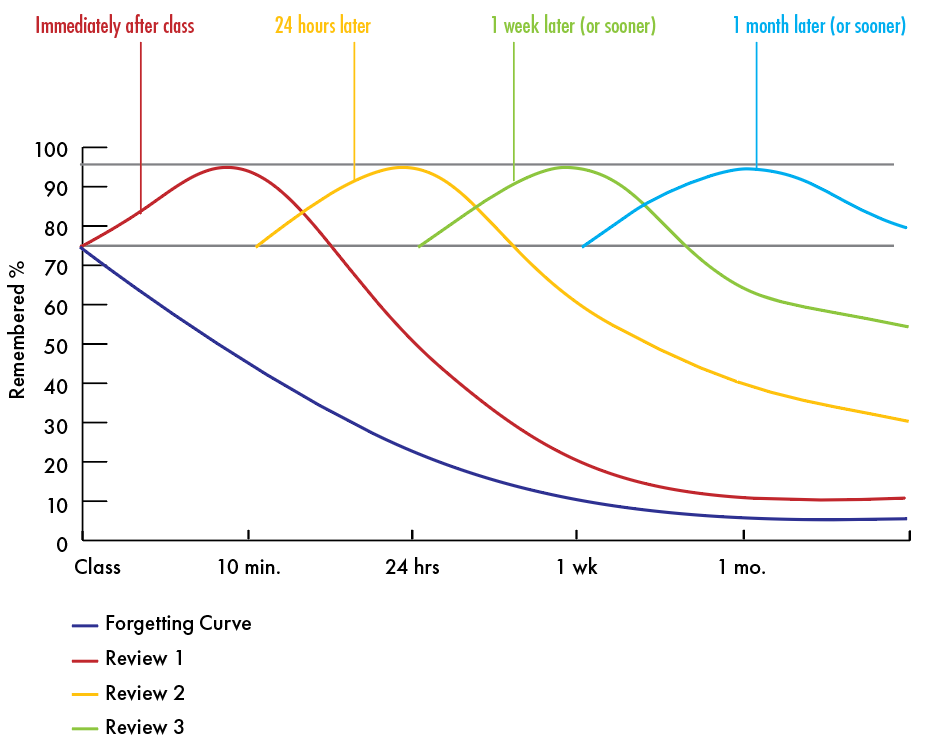
Spaced repetition means going back to the same material again and again, but with bigger gaps between the sessions. A good pattern is to revisit it after one day, after seven days, and after 14 days, and then again when studying for a test. You can make it even more effective by testing yourself on the different chunks/problems/sections of the information every time. Those you get right are put aside for next time. Those you get wrong have to be revisited tomorrow. Only when you know them well can you extend the period before you go back to them.
Cramming the material once may get you through a test, but if that’s all you do, you will have to start from scratch when you get to the exam. That is not an efficient use of your total study time. If you apply spaced repetition, you will spend less time in total on the material to get to the same level of understanding and retention. Research about the “forgetting curve” illustrates this very clearly.
Source: https://www.koobits.com/2012/10/08/study-smart-the-power-of-spaced-repetition
LEARN BY TEACHING

We learn much better when we learn to teach others. Working in a study group gives you the opportunity to take responsibility for a part of the work and present it to the rest of the group.
Even with all of these theories in your mind, you can study all day long while simply spinning your wheels. You may develop what Professor Oakley calls “illusions of competence in learning” – a frightening thought! Here are a few practical pointers to help you avoid that:
- Test yourself all the time. Make flash cards with a question/problem on one side and the solution on the other.
- Never do it only once. Repeat the information/process/formula until it flows like a song. Don’t only do a homework problem once. Pick some of the key ones, do them again, see if you can do them in your head. Learn them like a song.
- Don’t only highlight or reread information. Look at the page, then look away, and see what you can recall.
- Explain the material to someone else (or even out loud to yourself) so that a 10-year-old or your grandmother would understand it.
- Use analogies and metaphors to help you remember. Draw a mind map or some stick figures or make up a mnemonic.**
- Once you have mastered a range of problem-solving techniques, mix them up and work on different types of problems. This also goes for memorising factual content. Randomly flip through your book and pick out a problem or a section you need to remember. See whether you can solve it/recall it. If not, revisit that section.
- Understanding alone is not enough to bring mastery of the material. It has to be combined with practice and repetition in a variety of settings. Get up from your desk and go for a walk while repeating key terms or definitions, matching your rhythm to your footsteps.
- Exercise helps physiologically to retain information.
Making sense
Everything will be easier to understand and will stick with you much longer if you can MAKE SENSE of it, in other words, fit it into some existing knowledge and experience in your world. A few examples:
- If you’re studying civil engineering, find a bridge near where you live and look at it carefully. Is it supported from below, or does it hang from cables? How many? How widely spaced? If the concrete mix was wrong and it started crumbling, how would that play out?
- If you’re studying financial management, think of someone who bakes cookies for cash. She starts off with say R100. That’s the owner’s equity. She buys ingredients. That’s expenditure. She borrows a large pan to make the first batch. That pan is now a liability – she owes it to someone else, who wants some of the cookies as payment for the loan. That’s interest. How many cookies must she sell, at what price, to have enough profit for another batch?
- In literature, does the main character in a play you’re studying remind you of someone you know? Do you like that person? Why/why not? How does that fit with the character in the play?
Study groups
A group of friends who all want to do well at their studies can be a wonderful support for each other. Decide beforehand what a session will focus on so that you don’t waste time arguing about that, and use the time to do things like the following:
- The strongest student in a subject re-teaches a concept to the rest.
- Work together to solve problems.
- Compile flash cards to capture the main points of a piece of work.
- Come up with test/exam questions and answers.
- Discuss how something you learnt fits into the real world you live in.
- You can google “study group ideas” for more insight. Just be careful – you have to be disciplined so that it doesn’t become just a happy hangout with your mates!
Tools
Google the following:
- Mind maps – Tony Buzan
- Concept maps – Joseph Novak
- Thinking maps – David Hyerle
- Thinking hats – Edward de Bono
YOU HAVE TO SLEEP
- While you are awake, toxins collect in brain. That’s why we can’t think clearly when we are tired. When you sleep, your brain is “washed clean”.
- New synaptic connections form in the brain when you sleep.
- Do not cram. Many short learning periods interspersed with sleep build a neurological scaffold to hang new information on.

YOU HAVE TO EXERCISE
We used to think we are born with all the neurons we will ever have. That is not true. New neurons are born every day. This growth is essential to our ability to learn and remember new information. There are two ways to help them flourish: new environments, like university, travelling, or reading; or simply exercise. You don’t have to run a marathon – just go for a walk. Exercise enhances the growth and survival of neurons.

Some books/resources:
- The 5 elements of effective thinking, by Edward B. Burger and Michael Starbird
- Introduction to mathematical thinking, by Keith Devlin
- How to study as a mathematics major, by Lara Alcock
- How to become a straight-A-student, by Cal Newport
- 7 habits of highly effective people, by Stephen Covey
* Much of this comes from her TEDx Talk, “Learning how to learn”, and her book, A mind for numbers: how to excel at Math & Science (even if you flunked Algebra).
** Mnemonics are memory devices to help you recall larger pieces of information. One example: the order of operations for maths is Parentheses, Exponents, Multiply, Divide, Add, and Subtract. Turn the first letters into a sentence: Please Excuse My Dear Aunt Sally.
